
You’ve got a corridor that’s getting away from you. Maybe it’s a utility easement the power company keeps flagging, a pipeline right of way that’s grown in since the last clearing, or a roadside that’s turned into a wall of brush and saplings.
Whatever it is, you need it open again, and you don’t want to spend weeks hauling off debris or paying for a bucket truck crew to hand-cut every stem. We clear right of way corridors with a forestry mulcher in a single pass, leaving the ground covered and the access restored.
The scope on an ROW job usually comes down to two numbers: how long the corridor is and how wide you need it cleared. Once we have those, we can tell you what machine fits, how many days it’ll take, and what it’ll cost. Everything else gets sorted on the walk-through.
What Is Right Of Way Forestry Mulching?
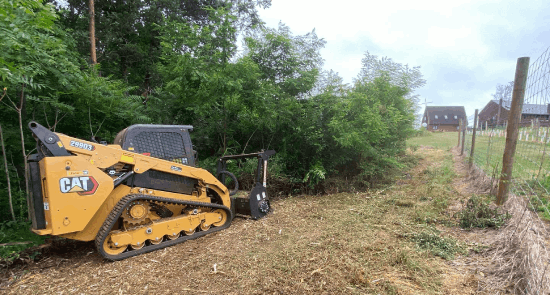
Right of way forestry mulching is a one-step clearing method built for linear corridors. We run a tracked machine fitted with a rotary drum cutter down the ROW, and the drum grinds standing brush, vines, and small trees into mulch right where they stand. Nothing gets piled, burned, or hauled off the site.
The mulch stays on the ground as a protective layer. That’s what makes ROW forestry mulching different from traditional clearing. No debris piles, no stump grinding as a separate step, no follow-up cleanup crew.

Where Forestry Mulching Fits In Right Of Way Maintenance
Forestry mulching rights of way work covers a lot of ground in Western North Carolina. If you manage a corridor that’s overgrowing, there’s a good chance this is the right tool for the job. We handle right of way maintenance on:
- Power line and utility easements
- Pipeline and gas line corridors
- Rural road shoulders and ditches
- Fence lines and property boundaries
- Logging roads and private access drives
Anywhere you need a clean, passable corridor without the mess of traditional clearing, a mulcher earns its keep.
Benefits Of Using A Right Of Way Mulcher
A right of way mulcher does the work of a crew with chainsaws, a chipper, a skid steer, and a dump truck, and it does it in a fraction of the time. That speed translates directly into lower cost per acre, which matters when you’re looking at a long corridor. One machine, one operator, one pass.
The benefits stack up fast:
- Single-pass clearing with no haul-off
- Mulch layer that controls erosion on slopes and ditches
- Slower regrowth thanks to the mulch smothering new sprouts
- Reduced fire fuel load along the corridor
- Minimal ground disturbance compared to dozing or grubbing
You end up with a corridor that looks finished the day we leave, not a staging ground full of brush piles waiting on a burn permit.
How The Process Works On An ROW Job
Every ROW job starts with a walk of the corridor. We look at the width you need cleared, the size of the material standing in it, the slope, and any obstacles like fences, anchors, or crossings. That walk tells us which machine to bring and how long the job will take.
Once we’re on site, ROW forestry mulching moves steadily from one end of the corridor to the other. The operator grinds everything in the cut path down to a layer of chips, working around anything that needs to stay. When we pull off the job, the corridor is open, the ground is covered, and you can see end to end.
Get A Quote For Your Right Of Way Project
Tell us about your corridor and we’ll set up a site visit. After we walk it, we’ll send you a written estimate with the scope and pricing laid out. If it’s a fit, we’ll get you on the schedule and get the ROW cleared.