
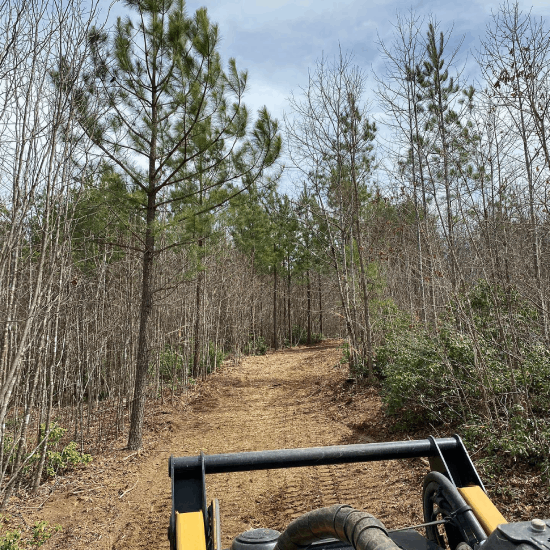
Your fence is out there somewhere under the briars, honeysuckle, and saplings. Maybe you can still see the top rail. Maybe the whole run has disappeared. Either way, you’re here because the fence isn’t doing what a fence is supposed to do, and cutting it back by hand sounds like a month of weekends you don’t have.
We get it. Fence lines are the first thing growth takes back and the last thing most property owners get around to fixing. When it’s finally time to deal with it, forestry mulching is the fastest way to get your fence line back to a clean, usable state.
Most of the fence lines we clear around here haven’t been touched in five or ten years, sometimes longer. The work isn’t complicated, but it has to be done carefully — the fence is the thing you’re trying to save, and the growth is packed in tight against it. That’s the part worth getting right.
Why Use A Forestry Mulcher On A Fence Line
A fence line is a long, narrow strip of work. The growth you need to remove is packed tight against wire, posts, and rails that you don’t want damaged in the process. That’s a bad fit for hand crews hauling brush piles and a worse fit for heavy equipment that needs room to maneuver. A forestry mulcher is built for exactly this kind of job.
The machine grinds standing trees, brush, vines, and undergrowth in place and drops the material on the ground as mulch. Nothing gets piled. Nothing gets hauled. There’s no burn pile, no permit, no debris bill at the end. When we’re done, your fence is visible, the ground along it is covered in a layer of mulch that slows regrowth, and your fence didn’t take any collateral damage on the way there.
It’s one machine, one pass, and a clean result you can actually walk.

Fence Line Clearing By Fence Type
Not every fence needs the same approach. A mulcher doing fence line forestry mulching along a barbed wire run works differently than one clearing growth off a chain link fabric. The fence itself dictates how close we can get, how aggressive we can be, and what the finished result should look like. Here’s how we handle each of the common fence types you’ll find on properties around here.
The fence types we work along most often:
- Barbed wire fences
- Woven and field wire fences
- Wood rail fences
- Electric fences
- Chain link fences
Every one of these has its own quirks, and the operator adjusts accordingly.
Barbed Wire Fences
Barbed wire is tough but unforgiving if the mulcher head catches a strand. We work the growth back from the wire itself, clearing the corridor on both sides without letting the head make contact. The wire stays tensioned, the posts stay standing, and the fence is visible end to end when we’re done.
Woven And Field Wire Fences
Woven and field wire catch vegetation like a net. Vines thread through the mesh and saplings grow up right against it. We clear down to the ground line so the wire sits fully exposed, with nothing pushing on the mesh or hiding rust and damage you need to see.
Wood Rail Fences
Wood rail fences look great when you can see them and awful when you can’t. We clear the growth away from posts and rails without contact, so the wood stays intact. The result is a fence that reads as a fence again from the road.
Electric Fences
Electric fences fail the moment vegetation touches the hot wire. Every leaf shorting the line bleeds off voltage until the whole fence stops working. We clear the run so the wire has clean air around it, which keeps the charge strong and the fence doing its job.
Chain Link Fences
Chain link is the one that really gets swallowed. Vines weave into the fabric, saplings grow through it, and eventually the fence becomes part of the hedge. We grind the growth back and clear the fabric so you can see the fence again and spot any sections that need repair underneath.
Fence Line Clearing In Hendersonville NC
We handle fence line clearing in Hendersonville NC and the surrounding Henderson County area. Growth moves fast in this part of the state, and a fence that was clear last spring can be buried by fall. We work across the full range of properties here, from a short residential run along the back of a lot to long pasture perimeters on acreage outside town.
If your fence is overgrown and you’re ready to do something about it, we can come take a look. Every property is a little different, and walking it in person is the only honest way to quote the work. Reach out and we’ll set it up.
Get A Quote For Your Fence Line
Request a quote through the form on this page or give us a call. We’ll come out to your property, walk your fence line with you, look at the growth and the fence condition, and put a price together for the job. No pressure, no obligation, just a straight quote so you know what the work costs and can decide from there.