
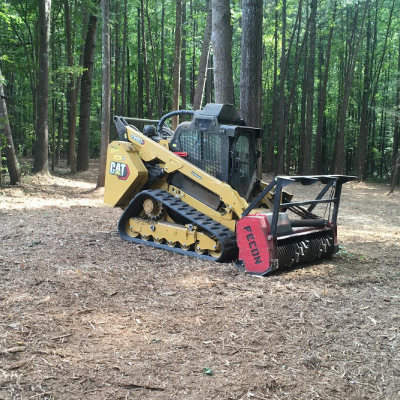
You’ve got acres you can’t walk through anymore. The back of the property is swallowed in briars, the old logging road is gone under ten years of volunteer growth, and the ridge you used to love is behind a wall of saplings and greenbrier. You want it back. You want trails you can actually use.
That’s what we do. We run forestry mulchers through overgrown ground and clear walkable corridors for nature trails on private property. No bare dirt, no hauling brush to the burn pile, no crew of guys with chainsaws working for a week. One machine, one pass, and you’ve got a cleared path you can walk the same day we finish.
Most of our nature trail jobs run a half acre to a few acres of corridor. We can clear a quarter-mile loop in a day, a longer ridge route in two or three. If you’ve been putting off the project because the brush has gotten away from you, that’s exactly the kind of job this machine was built for.
How To Plan A Nature Trail On Your Property
Before we show up, it helps to know roughly where you want the trail to go. The best trails follow the land instead of fighting it. Walk your property with a bundle of flagging tape and mark the route you want. Look for natural contours, gaps between larger trees, and the easiest grade between point A and point B.
A few things worth thinking through while you’re flagging:
- Loop or out-and-back
- Grade and steepness
- Drainage and wet spots
- Trees worth saving
- Destinations along the route
You don’t need a finished plan before you call us. If you have a rough idea and some flags in the ground, we can walk it with you and give you a realistic quote. Most of the work on our end is the clearing itself, but the planning is yours, and it’s worth taking time on.

Using A Forestry Mulcher To Clear Walking And Hiking Trails
A forestry mulcher is a tracked machine with a heavy drum head on the front. The drum spins fast and grinds standing brush, saplings, vines, and small trees into mulch that falls right onto the trail bed. Everything stays on the ground where it drops. There’s no burning, no piling, no hauling.
For a nature trail corridor, that’s exactly what you want. We move the machine along the flagged route and grind a path wide enough to walk comfortably. The mulch left behind settles into a walking surface that softens your footfall and slows weed regrowth for a season or two. Keep in mind the mulch can be chunky in spots, and depending on how you plan to use the trail, you may still want to come back through with gravel or rock dust to smooth it out. Either way, once we’re done you’ve got easy access and clear space to work with.
What Forestry Mulching Clears (And What It Doesn’t Build)
We clear the path. We don’t build the trail. That’s an important distinction, and it’s worth being clear about before you hire anyone.
What we do is grind down the vegetation in the corridor you’ve flagged and leave a mulched walking surface. That’s the job. It’s fast, it’s clean, and it’s what a forestry mulcher is built for.
What we don’t do is grade the trail bed, cut in drainage, install water bars, lay gravel, or shape the tread. Trail building is a separate trade with different equipment and a different skill set. If your trail needs cut-and-fill grading on a steep sidehill, drainage structures, or a finished tread surface, you’ll want a trail builder after we’ve cleared the corridor. For most property owners who just want a walkable path through overgrown woods, the mulched corridor is all they need.
What A Forestry Mulcher Can (And Can’t) Handle
Our mulcher handles anything up to four inches in diameter. Brush, briars, greenbrier, multiflora rose, honeysuckle, autumn olive, saplings, small pines, and volunteer hardwoods under four inches all get ground down without slowing the machine.
Anything over four inches is a different job. Larger trees need a chainsaw crew, and if you want the stumps gone after that, you’re looking at a stump grinder or an excavator. We can work around bigger trees and leave them standing, which is usually what you want on a nature trail anyway. But we can’t take them down with the mulcher, and we won’t try.
If you walk your route and see a few larger trees in the way, flag them and let us know. We’ll either route around them or recommend someone to drop them before we come in.
Types Of Trails We Clear
Most of what we clear falls into a few categories. The width and the finish are the main variables, and we size the corridor to match what you’re using the trail for.
- Walking trails: four to five feet wide, easy grade
- Hiking trails: wider corridors for longer routes
- Mountain bike paths: cleared wide enough for flow and sight lines
- ATV and UTV trails: eight to ten feet wide for a side-by-side
- Fence line paths: narrow corridors along a property line
- Hunting trails: routed to stands and food plots
- Connector paths: short sections linking trails or fields
Whatever you’re clearing for, the work looks about the same from the machine’s side. Tell us what the trail is for and we’ll clear it to fit.
Hand-Clearing And Bulldozing Vs. Forestry Mulching
There are three common ways to open a trail through overgrown woods, and they give you three very different results.
Hand-clearing with chainsaws and machetes is the slowest. A two- or three-person crew can open a few hundred feet a day through heavy brush, and then someone has to haul or burn all the cut material. The labor adds up fast, and the trail bed is rough, with stumps, stobs, and cut ends sticking out of the ground everywhere you step.
Bulldozing is the fastest and the worst. A dozer scrapes everything, including brush, topsoil, and root mat, and leaves you with bare dirt, ruts, and a trail that washes out the first hard rain. You can bulldoze a trail in an afternoon and spend the next three years trying to stabilize it.
Forestry mulching sits in the middle on speed and ahead of both on finish. We clear as fast as a dozer, and we leave behind a stable mulch bed instead of bare dirt. No hauling, no burning, no erosion. The ground stays intact, the trail holds up, and the only thing missing is the brush you wanted gone.
Finishing The Trail After We’re Done
Once we’ve cleared the corridor, the trail is walkable, but most property owners do a little follow-up work to get it exactly how they want it. None of this is required. It depends on how polished you want the finished trail and how hard you plan to use it.
A few things worth considering after the clearing is done:
- Gravel or rock dust to smooth chunky spots and firm up the walking surface
- Compaction on soft or low areas that might hold water
- Spot herbicide treatment on stumps and roots to slow regrowth
- Edging with flagging, stone, or cut logs to define the trail line
- Drainage cuts on any stretches that run downhill
- Follow-up mulching every few years to knock back new growth
None of it has to happen right away. Plenty of owners walk the trail for a season first, see where it holds up and where it doesn’t, and do the finish work the following year. The mulched corridor gives you the access to make those calls without fighting through brush every time you want to check on it.
Get A Quote For Your Nature Trail
If you’ve got an overgrown piece of property near Hendersonville, NC and you want trails you can actually walk, we can help. Send us the details through the form and we’ll set up a site visit to walk the property with you, look at the route you have in mind, and give you a quote for the clearing.